This is National Parks Week, a time to celebrate the U.S. park system. I have visited and loved many of the
nation’s parklands, beginning in childhood. My father’s long summer breaks as a school teacher allowed us to go on camping vacations throughout the American West, and national parks were always our favorite destinations. They remain among my most treasured places.
In recent years, my deep affection for national parks has been tempered with ambivalence as I have researched their history (I discuss this ambivalence in
my forthcoming book on Yellowstone, which will be published in July). Contrary to what many people assume, the parks were not created as places of wilderness preservation. Instead, they started in the context of Manifest Destiny as the United States expanded to spread Christian civilization across the continent. The two essays featured
below explain this early history of U.S. national parks.
Learning how the parks were first created helps me to understand the current challenges they face. Climate change, overcrowded conditions, inadequate budgets and staffing—the list is long. Many of the most serious problems for U.S. national parks can be traced to the founding of the earliest parks.
When they were first created in the nineteenth century, national parks catered primarily to a wealthy class of leisure travelers. Over time, more middle-class vacationers were able to enjoy them. For all visitors, the parks offer boundless recreational opportunities: sightseeing, hiking, camping, backpacking, rock climbing, canoeing and kayaking, photography, learning history, engaging with diverse cultures.
Sadly, the priorities of the current administration are bringing changes to these national treasures. With the rhetoric of efficiency, deregulation, and energy independence, traditional protections are being swept aside as park budgets and staff are drastically cut. The unspoken
goal appears to be privatization, which would turn national parks into luxury resorts for the wealthy. It appears they may eventually become what they were in the beginning, destinations for an elite class of wealthy travelers.
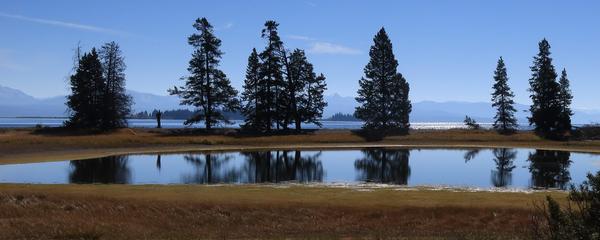
For now, though, national parks belong to everyone. I hope that you can take time this week to visit a park near you. The National Park Service has suggestions on their website for you to engage with the parks. If you can’t get there IRL, then perhaps you can make a virtual visit through one of the many webcams that the Park Service maintains,
such as these in Yellowstone.
Kind regards.
Tom
Recent essays
National Park Origins—Part 1: Myth and history in creating Yellowstone:As a child I learned that national parks began around a campfire in Yellowstone. As a historian, I discovered that the campfire myth was concocted years later and popularized by a rather shifty character, Nathaniel P. Langford. This first part of the actual history of national park origins tells a more complicated tale of an influential
nineteenth-century banker’s scheme to entice investors for a transcontinental railroad.
National Park Origins—Part 2: Shrines to a Manifested Destiny: National parks in the U.S. are often seen as places of natural beauty, but their origins are tied to Manifest Destiny—the belief that Americans were destined to
settle and civilize the continent. National parks became symbols of national progress, reinforced by art depicting western expansion. While they offer refuge and inspiration, their history is also marked by conquest and exclusion of Native Americans, displacing them from sacred lands.
Featured Photo
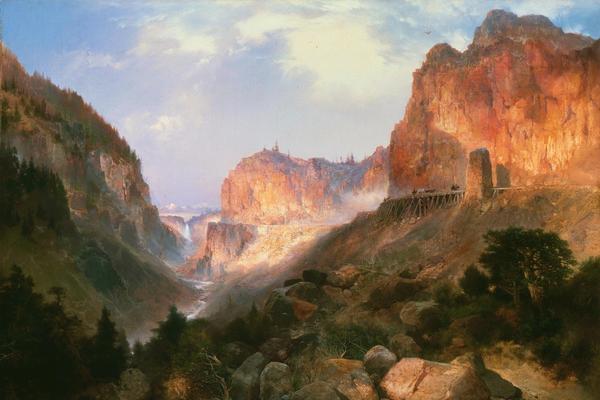
Lower Falls of the Yellowstone River, Yellowstone National Park
(photo by T.S. Bremer)
I worked for a concessionaire at Canyon Village in Yellowstone during the summer season of 1978. When I arrived the first week in May, the park had just opened and there were few visitors. I often had the Grand Canyon of the Yellowstone to myself that first month of my stay. I enjoyed the solitude of sitting on the canyon rim and watching the
ospreys play on the updrafts of the canyon. Many times I contemplated the spectacular falls and the vibrant colors of the canyon walls with the distant roar of the river the only sound.
Springtime resurrections: "Along with the butterflies, bears are rising from their dens. All of them are potent reminders of the reality of resurrection." Seasons of Resurrection | Mountain Journal
Climate optimism: "It’s about shifting the narrative on the challenges we’re facing 'so that we can act with courage, curiosity and excitement, instead of getting stuck in anxiety
and fear,'" says Anne Therese Gennari, a.k.a. The Climate Optimist. What is climate optimism? | Imagine5
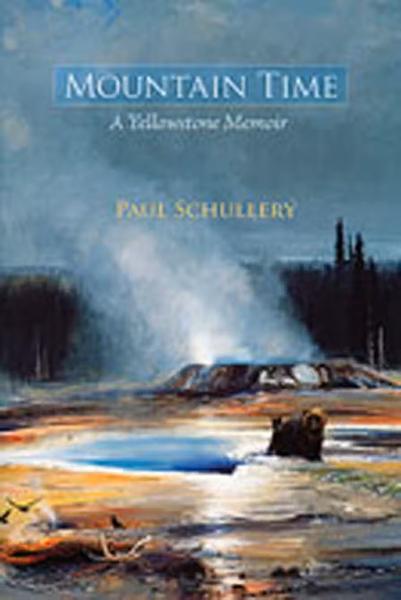
This book ranks alongside Henry David Thoreau’s Walden, Aldo Leopold’s Sand County Almanac, and Annie Dillard’s Pilgrim at Tinker Creek as one of my favorite
nature books. Paul Schullery writes with humor and intelligence in this memoir of a place where he discovered a “feeling of being home” and also “a sense of wonder.” In picking it up again this week, I find the opening lines of the Preface especially relevant in this time of political and cultural upheaval: “A wise friend of mine, a biologist, once told me, ‘Whenever things are going particularly badly I take a walk in the sage above the cabin and sit there thinking about the park in geological
terms. That helps keep what happens in the next hundred years in perspective.’” Our present moment seems to hardly matter in the vast stretches of mountain time.
Breaking into blossom
James Wrighthas earned a place among the great American poets
of the twentieth century. He has been praised for having “the gift of using language in a way that the human spirit is awakened and alerted to its own possibilities." This is true of “A Blessing,” one of his most famous poems, which tells of encountering a pair of horses during a stop on a road trip.
A Blessing
Just off the highway to Rochester, Minnesota,
Twilight bounds softly forth on the grass.
And the eyes of those two Indian ponies
Darken with kindness.
They have come gladly out of the willows
To welcome my friend and me.
We step over the barbed wire into the pasture
Where they have been grazing all day, alone.
They ripple tensely, they can hardly contain their happiness
That we have come.
They bow shyly as wet swans. They love each other.
There is no
loneliness like theirs.
At home once more,
They begin munching the young tufts of spring in the darkness.
I would like to hold the slenderer one in my arms,
For she has walked over to me
And nuzzled my left hand.
She is
black and white,
Her mane falls wild on her forehead,
And the light breeze moves me to caress her long ear
That is delicate as the skin over a girl’s wrist.
Suddenly I realize
That if I stepped out of my body I would break
Into blossom.
– James Wright
[Source: James Wright, The Branch Will Not Break (1963), page 57]
I would love to hear from you.
You can reach me by replying to this email or clicking on the Contact button.